
Money tells a story. For a business, that story is usually simple: revenue in, expenses out, profit at the end. But for a charity, a foundation, or a community organization, the story is far more layered. A single bank account might hold a grant restricted to a youth mentorship program, a donation earmarked for a building renovation, and general operating funds that keep the lights on. Treating all of that money the same way isn’t just messy bookkeeping it can breach donor trust, violate grant terms, and put an organization’s tax-exempt status at risk.
This is exactly why non profit fund accounting exists as its own discipline, separate from standard business accounting. If you run or manage the finances of a nonprofit, understanding this system isn’t optional it’s the backbone of transparency, compliance, and long-term sustainability.
What Is Fund Accounting, and Why Does It Work Differently for Nonprofits?
At its core, fund accounting is a method of tracking money based on its purpose rather than simply its total balance. Instead of one big pool of cash, a nonprofit’s finances are divided into separate “funds,” each representing a specific source or restriction on how the money can be used.
For example, a nonprofit might maintain:
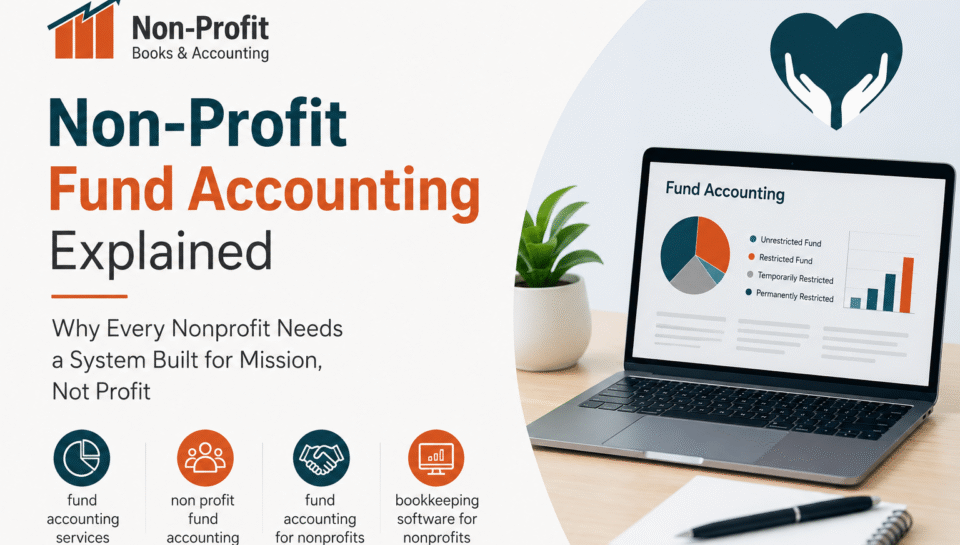
- An unrestricted fund for general operations, salaries, and day-to-day expenses
- A temporarily restricted fund for a grant that must be spent on a specific project within a specific timeframe
- A permanently restricted fund, such as an endowment where only the investment income can be spent, not the principal
Traditional for-profit accounting asks, “How much did we earn, and how much did we keep?” Fund accounting for nonprofits asks a different question entirely: “Are we spending this money the way our donors, grantors, and board intended?”
That distinction matters enormously. A business can move revenue between departments as it sees fit. A nonprofit cannot simply shift a donor-restricted gift into payroll because cash flow is tight that month. Doing so could mean breaking a legal agreement with a funder, damaging the organization’s reputation, or even triggering a repayment demand.
The Core Principles Behind Fund Accounting
Nonprofit fund accounting rests on a few foundational ideas that shape everything from daily bookkeeping to annual audits.
1. Accountability over profitability. Nonprofits don’t exist to generate profit for shareholders. Their financial statements are designed to answer a different question: did the organization use its resources responsibly and in line with its mission?
2. Fund restrictions must be honored. Every dollar that comes with strings attached whether from a government grant, a corporate sponsor, or an individual donor’s designated gift needs to be tracked separately until it’s spent according to those terms.
3. Transparency for stakeholders. Board members, donors, grantmakers, and regulators all need clear visibility into how money moves through the organization. Fund accounting makes it possible to produce reports that show exactly where restricted and unrestricted dollars went.
4. Compliance with accounting standards. In the U.S., nonprofits generally follow guidance from the Financial Accounting Standards Board (FASB), which requires organizations to classify net assets as either “with donor restrictions” or “without donor restrictions.” Getting this classification wrong can distort financial statements and create headaches during audits or tax filings.
Why Generic Bookkeeping Falls Short for Nonprofits
It’s tempting for a smaller nonprofit to think a standard bookkeeping setup the kind used by a retail shop or a freelance consultant will do the job. In practice, this almost always creates problems down the line.
Generic accounting software and generalist bookkeepers are built around a single bottom line. They’re not designed to track multiple restricted funds simultaneously, allocate shared expenses (like rent or a shared staff member’s salary) across programs, or produce the specific reports that grantors and auditors expect, such as a Statement of Functional Expenses.
Without a proper fund accounting structure, organizations often run into:
- Commingled funds that make it impossible to prove restricted money was spent correctly
- Inaccurate grant reporting, which can jeopardize future funding
- Failed audits due to improper net asset classification
- Board and donor distrust stemming from unclear or inconsistent financial reports
- Wasted staff time reconciling accounts manually instead of focusing on mission-driven work
This is where dedicated fund accounting services make a measurable difference. Rather than forcing a nonprofit’s complex, multi-fund reality into a tool built for simple profit-and-loss tracking, these services are designed from the ground up to handle restricted and unrestricted funds, grant compliance, and nonprofit-specific reporting standards.
What Good Fund Accounting Services Actually Include
Not all bookkeeping support is created equal, and nonprofits should know what to look for when evaluating a provider. Comprehensive fund accounting services typically cover:
Fund-level tracking and reporting. Every restricted grant, endowment, or designated gift is tracked in its own ledger, with reports that show the balance, activity, and remaining restrictions at any point in time.
Statement of Financial Position and Statement of Activities. These nonprofit-specific equivalents of a balance sheet and income statement break down net assets by restriction category, giving boards and funders an accurate picture of financial health.
Functional expense allocation. Nonprofits must report expenses by function program services, management and general, and fundraising not just by category like salaries or supplies. A capable fund accounting service builds allocation methodologies that hold up to audit scrutiny.
Grant and contract compliance tracking. Many grants come with specific reporting deadlines, spending caps, and documentation requirements. Proper fund accounting ensures an organization can produce accurate, timely reports for each funder.
Audit preparation and support. Come audit season, an organization with clean fund-based records spends far less time scrambling and far more time confirming what’s already accurate.
Board-ready financial reporting. Board members typically aren’t accountants. Good fund accounting services translate complex fund data into clear dashboards and summaries that support informed governance decisions.
Choosing the Right Partner for Nonprofit Fund Accounting
Because the stakes around compliance and donor trust are so high, choosing who manages your books matters as much as the accounting method itself. This is precisely the gap that Non-Profit Books was built to fill. Rather than adapting a generic small-business bookkeeping model, Non-Profit Books focuses specifically on the needs of mission-driven organizations from small community nonprofits to larger multi-program organizations juggling dozens of active grants.
A specialized partner like Non-Profit Books brings a few key advantages that a generalist accountant often can’t match:
- Familiarity with nonprofit-specific software configured for fund-level tracking rather than retrofitted from for-profit templates
- Experience with FASB nonprofit reporting standards, so financial statements are audit-ready from the start
- An understanding of grant compliance timelines, reducing the risk of missed reporting deadlines that could jeopardize future funding
- The ability to translate complex fund data into plain language for boards, executive directors, and program managers who need to make decisions quickly
For an organization juggling limited staff and a mission that always feels more urgent than paperwork, having a team that already speaks the language of restricted funds, functional expenses, and donor intent can save enormous time and prevent costly missteps.
Common Questions Nonprofit Leaders Ask
Does every nonprofit need fund accounting, even small ones? Yes. Fund accounting isn’t reserved for large organizations with complex grant portfolios. Even a small nonprofit with a single restricted donation needs to track that money separately from general funds to stay compliant and maintain donor trust.
How is fund accounting different from regular bookkeeping software? Standard bookkeeping tools are built to track overall profitability. Fund accounting systems are structured around multiple funds with different restrictions, and they generate the specific statements like net assets with and without donor restrictions that nonprofits are required to report.
Can fund accounting help during an audit? Absolutely. Auditors specifically look for evidence that restricted funds were spent according to donor or grantor terms. Clean, fund-based records make audits faster, less stressful, and less costly.
What happens if restricted funds are misused, even accidentally? Even unintentional misuse of restricted funds can lead to serious consequences: repayment demands from funders, loss of future grant eligibility, or reputational damage that affects an organization’s ability to fundraise going forward. This is precisely why dedicated tracking systems matter so much.
The Bottom Line
Non profit fund accounting isn’t just a technical requirement buried in an accounting manual it’s the financial framework that protects an organization’s integrity, its relationships with funders, and ultimately its ability to keep doing the work it exists to do. Every restricted grant honored correctly, every board report that clearly shows where money went, and every audit that closes without red flags builds the kind of trust that keeps donors giving and funders funding.
For organizations that want that framework handled by people who understand it inside and out, working with a specialized partner focused on fund accounting for nonprofits like Non-Profit Books can be the difference between financial systems that merely function and financial systems that actively support the mission. When the books are clear, restricted funds are honored, and reporting is audit-ready, nonprofit leaders can spend less time worrying about spreadsheets and more time doing what they set out to do in the first place.