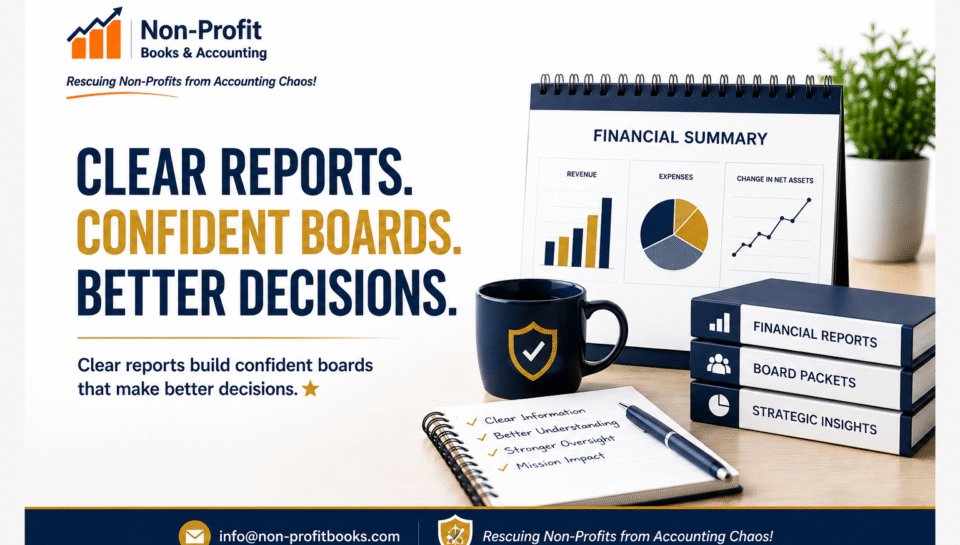

The best board reports don’t overwhelm people with numbers. They give leaders the clarity to make confident decisions.
Every board meeting includes a familiar moment.
The financial reports are distributed.
Board members quietly review page after page of figures, ask a few questions, approve the reports, and move on to the next agenda item.
The reports are complete.
The numbers are accurate.
Yet many Executive Directors leave the meeting wondering whether the board truly understands the organization’s financial position.
The problem usually isn’t the accuracy of the reports.
It’s that the reports weren’t designed to answer the questions board members are actually asking.
Strong financial reporting isn’t about sharing more numbers.
It’s about helping leadership understand what those numbers mean.
Why This Happens
For example, a noAs nonprofit organizations grow, their financial information naturally becomes more complex.
New grants require additional tracking.
Programs expand.
Funding sources increase.
Expenses become more detailed.
Over time, financial reports often grow longer because more information is added.
Unfortunately, more information doesn’t always create more understanding.
Finance teams may prepare reports that accurately reflect every transaction, while board members are trying to answer much simpler questions.
Questions like:
- Are we financially healthy?
- Are we staying within our budget?
- Do we have enough cash to support upcoming programs?
- Are donor restrictions being managed appropriately?
- Is there anything that requires the board’s attention today?
When reports focus primarily on accounting details, those questions often remain unanswered.
The Hidden Cost of Confusing Reports
When financial reports are difficult to understand, the impact extends far beyond the board meeting itself.
Imagine a board receiving a twenty-page financial packet.
Every figure is accurate.
Every reconciliation has been completed.
But after reviewing the reports, no one feels confident explaining whether the organization is ahead of budget, facing cash flow concerns, or carrying unexpected financial risks.
Instead of discussing strategy, leadership spends valuable meeting time explaining line items.
Board members may avoid asking questions because they don’t want to appear unfamiliar with nonprofit finance.
Eventually, financial oversight becomes reactive rather than proactive.
The organization still has financial reports.
What it lacks is financial clarity.
As Organizations Grow, Clear Reporting Becomes Even More Important
ItGrowth brings new opportunities, but it also increases responsibility.
Additional grants create more reporting requirements.
New programs require closer financial oversight.
Larger teams create more payroll responsibilities.
Boards become responsible for overseeing more complex financial decisions.
The reports that worked for a small organization may no longer provide the information leadership needs.
As complexity increases, reports should become clearer—not longer.
Strong reporting helps leadership focus on the organization’s future instead of spending every meeting interpreting financial statements.
What Strong Nonprofits Do Differently
Organizations with strong financial systems understand that board reports are leadership tools, not accounting documents.
They don’t simply provide financial statements.
They provide context.
That often includes:
- A one-page executive summary.
- Budget compared with actual results, along with explanations for significant differences.
- Cash flow updates.
- Summaries of grant activity and restricted funds.
- Key financial trends from the previous reporting period.
- Important risks or opportunities that deserve the board’s attention.
When financial information is presented this way, board members spend less time decoding reports and more time asking thoughtful questions that support the organization’s mission.
The conversation shifts from understanding the numbers to making informed decisions.
Practical Ways to Improve Board Reporting
Organizations with strong financial systems understand that board reports are leadership tools, not accounting documents.
They don’t simply provide financial statements.
They provide context.
That often includes:
- A one-page executive summary.
- Budget compared with actual results, along with explanations for significant differences.
- Cash flow updates.
- Summaries of grant activity and restricted funds.
- Key financial trends from the previous reporting period.
- Important risks or opportunities that deserve the board’s attention.
When financial information is presented this way, board members spend less time decoding reports and more time asking thoughtful questions that support the organization’s mission.
The conversation shifts from understanding the numbers to making informed decisions.
Practical Ways to Improve Board Reporting
Better reporting doesn’t always require more work.
Often, it simply requires presenting information differently.
Consider these practices:
- Begin every report with a short executive summary.
- Explain significant changes instead of expecting board members to identify them.
- Use clear, conversational language instead of accounting terminology whenever possible.
- Include simple charts or dashboards that highlight important trends.
- Connect financial results to organizational goals and upcoming priorities.
- Keep detailed supporting schedules available for anyone who wants additional information, but let the main report focus on what leadership needs to know.
The goal isn’t to simplify the organization’s finances.
It’s to make financial information easier to understand.
A Question Worth Asking
If a new board member attended your next meeting, would they understand your organization’s financial position after reading the reports?
Or would someone need to explain what the numbers mean before they could participate in the discussion?
Strong governance depends on more than accurate financial statements.
It depends on reports that help board members understand where the organization stands today and where it is headed tomorrow.
Because the purpose of financial reporting isn’t simply to document the past.
It’s to help leadership make better decisions for the future.
Ready to Strengthen Your Board Reporting?
If your board receives accurate financial reports but still struggles to understand the organization’s financial picture, it may be time to improve how information is presented.
Schedule a no-cost financial process review to explore how clearer reporting can strengthen board confidence, improve decision making, and help your organization stay focused on its mission.