
The expense was recorded. The payroll was processed. The transaction made it into the books. So why might your numbers still be misrepresenting your organization?
If you run a nonprofit, you already know the bills get paid and the transactions get entered. That part is rarely the problem. The harder question — the one that quietly shapes how funders, boards, and the IRS see you — is whether those expenses are being categorized correctly across your three functional areas: programs, management and general (administration), and fundraising.
This is the work of functional expense allocation, and it’s one of the most commonly overlooked drivers of how a nonprofit appears on paper. Get it right, and your financials start answering questions. Get it inconsistent, and they start raising them.
Recording an expense and categorizing it are two different jobs
It’s an easy issue to overlook. After all, the bill was paid and the transaction is in the system. But where that expense ultimately lands — which function it’s attributed to — matters more than many organizations realize.
Consider a single staff salary. A program director might spend most of their week running services, some of it managing operations, and a slice of it preparing a grant appeal. That one paycheck legitimately belongs across all three functional categories. The same is true of shared costs like rent, software subscriptions, utilities, and insurance. None of them belong entirely to one function — they have to be split.
How you split them is the methodology. And that’s exactly where most of the trouble starts.
The real problem isn’t carelessness — it’s that the rules live in someone’s head
The challenge usually isn’t sloppiness. It’s that allocation rules depend on consistency, and those rules often live in one person’s memory rather than in a documented system. Shared costs get divided based on assumption, habit, or “how we’ve always done it” instead of a clearly defined, written methodology tied to the books.
That creates a subtle drift over time:
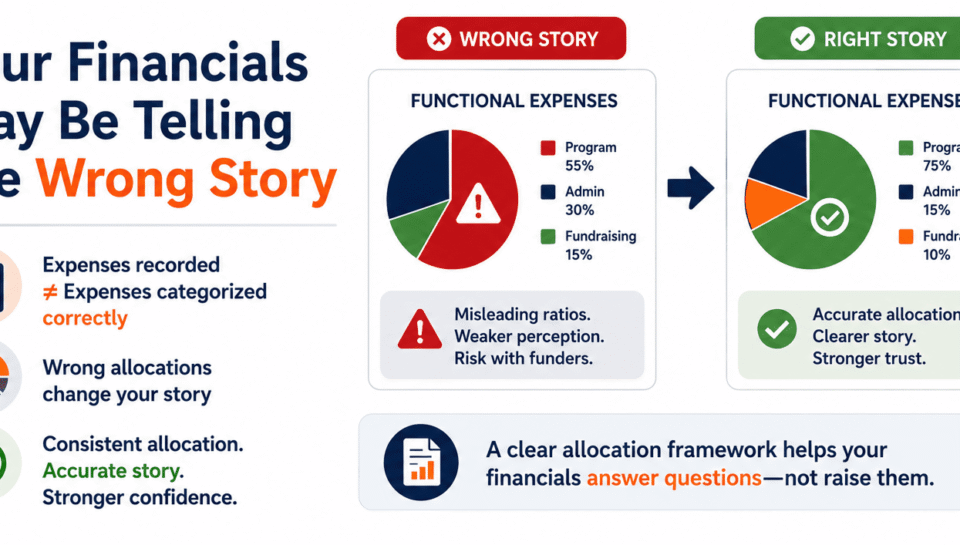
- Your program ratio may look weaker than it truly is, making your organization appear less efficient than it actually operates.
- Your overhead may appear higher than reality, which can make funders hesitate.
- Your Form 990 — particularly the Statement of Functional Expenses — may end up telling a story that doesn’t fully reflect how resources are actually being used.
And because the drift is gradual and the bills were all paid correctly, nobody notices until a board member, a grantmaker, or a charity-rating site asks a pointed question about your numbers.
Why funders care about the program ratio
The program ratio (program expenses divided by total expenses) is one of the first figures donors and watchdog organizations look at. An allocation method that under-counts program activity can make a healthy, mission-focused organization look top-heavy — purely as an accounting artifact, not a reflection of reality.
What a clear allocation framework actually looks like
The good news is that the fix is rarely complicated. Most organizations simply need a documented framework that is applied consistently all year and tied directly to the nonprofit chart of accounts and reporting process. A workable methodology usually comes down to a few decisions:
1. Choose a defensible allocation basis for each shared cost
Different costs call for different bases. Salaries are commonly allocated by time studies or reasonable estimates of staff effort. Rent and utilities are often allocated by square footage or headcount. Software might be allocated by user or by function. The key is that each basis is reasonable, documented, and repeatable.
2. Tie the methodology to your chart of accounts
Allocation can’t live in a side spreadsheet that one person maintains. It should be built into how your books are structured so that expenses are coded with intention as they’re entered — not reverse-engineered at year-end. A well-designed chart of accounts makes functional reporting a byproduct of normal bookkeeping rather than a separate project.
3. Apply it consistently — and write it down
A methodology is only as good as its consistency. Document the rules, apply them every month, and revisit them when programs or staffing change. When the logic is written down, it survives staff turnover and stands up to scrutiny from auditors, boards, and funders.
4. Reconcile allocation with fund accounting
Functional allocation works alongside fund accounting and grant tracking. Restricted grants often require you to demonstrate how funds were spent by function. A consistent allocation method makes grant reporting cleaner and reduces the risk of misstating how restricted dollars were used.
When expenses are coded with intention, the numbers start working for you
This is the payoff. When your functional expense allocation is consistent and documented, your financials stop being a source of anxiety and start being a tool. They help your board make decisions with confidence. They help funders understand your true impact and efficiency. And they support the kind of financial transparency that builds long-term trust with everyone who supports your mission.
Most importantly, your Form 990 and audited statements begin to reflect what’s actually happening inside your organization — not an accidental story created by inconsistent coding.
A quick self-check for your organization
Ask yourself a few questions:
- If our lead bookkeeper left tomorrow, could someone else reproduce our allocation method from a written document?
- Can we explain, in one sentence, how we split salaries, rent, and software across functions?
- Does our chart of accounts make functional reporting automatic, or do we rebuild it manually each year?
- Would our program ratio hold up if a major funder asked us to walk through it?
If any of those gave you pause, you’re not alone — and it’s a very fixable gap.
See how your allocation approach compares
If you’re curious how your current functional expense categorization stacks up against common nonprofit practices, our team can review your setup and show you where the quick wins are — usually starting with your chart of accounts and Form 990 reporting.
Book a free consultation →