
Every nonprofit has that one person. The one who knows where every transaction lives, how the chart of accounts is structured, and why a particular grant gets tracked a certain way. When a question comes up, the answer is always the same: “Ask her—she’ll know.”
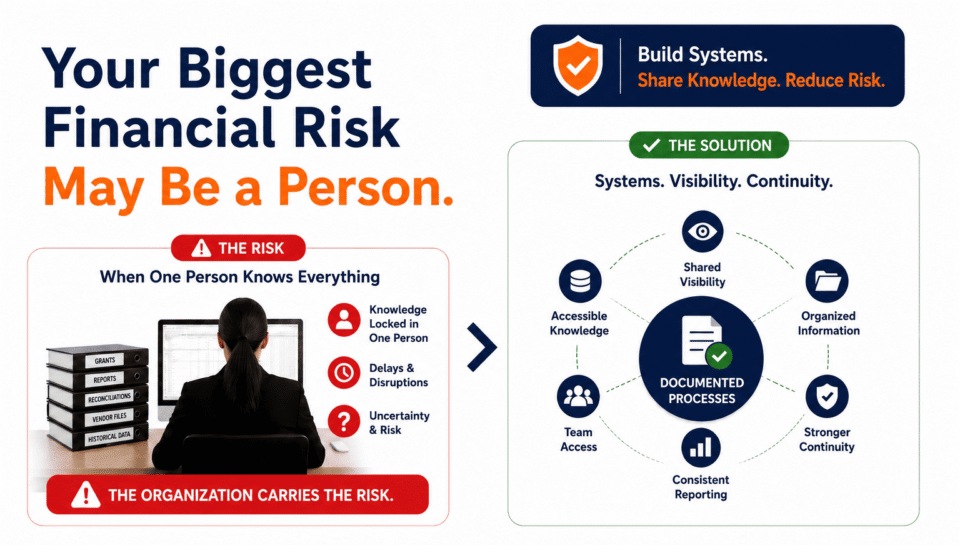
It feels like a strength. In reality, it’s one of the quietest risks a nonprofit can carry. When financial knowledge lives with a single person instead of inside the organization, you don’t have a bookkeeping system—you have a single point of failure. And single points of failure tend to reveal themselves at the worst possible moment.
This is what’s known as key person risk, and for lean, mission-driven organizations, it’s far more common than most boards realize.
Why Nonprofits Are Especially Exposed
Key person risk isn’t a sign that anyone did anything wrong. It’s structural. In small and mid-sized nonprofits, capable people naturally absorb more and more responsibility over time. The bookkeeper who started by reconciling the bank account gradually becomes the only person who understands fund accounting, grant tracking, restricted vs. unrestricted balances, and the logic behind year-end reporting.
Because that knowledge accumulates slowly and quietly, it rarely gets documented. The processes work—until the person running them is unavailable. Then leadership discovers that nonprofit bookkeeping for a multi-funder organization is genuinely complex, and that almost none of it was written down.
Consider a real pattern we see often. A mid-sized nonprofit’s long-time bookkeeper gives two weeks’ notice after nearly nine years. At first, leadership isn’t worried. Then the questions start:
- How are grants being tracked across funders?
- Why is this fund coded differently from that one?
- Where are the supporting records behind last quarter’s report?
- Which reconciliations happen monthly, and which are quarterly?
Month-end close slows down. Routine questions suddenly take days. Processes that once felt automatic now feel uncertain. The issue was never the bookkeeper. The issue was that the entire system depended on the bookkeeper.
The Hidden Costs of Concentrated Financial Knowledge
When your nonprofit financial management rests on one set of shoulders, the risks compound in ways that aren’t obvious day to day:
Reporting slows when you can least afford it. If a board meeting, audit, or grant report is due during a transition, you may not be able to produce accurate nonprofit financial statements on time. Funders and auditors don’t pause for staffing gaps.
Compliance becomes guesswork. Grant compliance and fund accounting rules are unforgiving. If only one person understood how restricted funds were tracked, a departure can put your grant management and reporting accuracy at real risk.
Oversight weakens. Boards and executive directors are responsible for financial stewardship, but they can’t provide meaningful oversight of a process they can’t see. Concentrated knowledge quietly erodes internal controls for nonprofits, including the separation of duties that protects against errors and fraud.
Institutional memory walks out the door. Nine years of context—why decisions were made, how edge cases are handled, what funders expect—is incredibly hard to rebuild from scratch.
None of this is a reflection on the person at the center of it. It’s a reflection of how the organization built its nonprofit accounting process around an individual instead of around a system the whole organization can follow.
From “Only She Knows” to “Anyone Can See”
The good news is that key person risk is fixable, and the solution is not replacing anyone. It’s a deliberate shift: moving financial knowledge out of one person’s head and into documented, shared systems. The nonprofits that handle transitions best all have one thing in common—their financial knowledge belongs to the organization, not to a single desk.
Here’s what that shift looks like in practice.
1. Document your core financial procedures
Start by writing down the recurring processes that currently live only in someone’s memory: the month-end close checklist, how revenue and grants are recorded, reconciliation steps, and reporting routines. A simple, maintained set of bookkeeping procedures turns invisible knowledge into a repeatable process. If a new person stepped in tomorrow, could they follow it?
2. Standardize reporting and your chart of accounts
A clean, well-structured nonprofit chart of accounts and consistent reporting workflows mean your numbers don’t change meaning depending on who prepares them. Standardization is what makes financial reports trustworthy month after month, regardless of who’s at the keyboard.
3. Organize fund and grant tracking
For organizations juggling multiple funders, clear fund accounting and grant-tracking structures are essential. Each funder’s requirements, restrictions, and reporting deadlines should be documented and visible—not reconstructed from memory each cycle.
4. Build shared financial visibility
Leadership and the board should be able to see the organization’s financial position without having to ask one person to interpret it. Dashboards, standardized monthly reporting packages, and clear documentation give decision-makers real financial oversight and reduce dependence on any single individual.
5. Strengthen internal controls and separation of duties
Even small teams can build basic internal controls—a second set of eyes on reconciliations, approval workflows for payments, and documented review steps. These controls protect the organization and make knowledge inherently shared rather than concentrated.
6. Consider outsourced nonprofit bookkeeping for continuity
One of the most effective ways to eliminate key person risk is to not rely on a single person at all. Outsourced bookkeeping for nonprofits replaces a one-person dependency with a team and a documented system. Reporting, fund tracking, and compliance continue uninterrupted even when an individual is out, on leave, or moves on. Continuity stops being something you hope for and becomes something built into the model.
A Simple Test for Your Organization
If you want a quick gauge of your own exposure, ask yourself one question: If our key financial person were unavailable tomorrow, how long would it take to produce accurate financial reports?
If the honest answer is “we’re not sure,” that’s worth a closer look—not because anything is wrong, but because that uncertainty is the risk itself. The goal isn’t to distrust a valued team member. The goal is to make sure the organization can keep moving forward no matter who is at the desk.
Protect Your Mission by Protecting Your Financial Continuity
Your nonprofit’s finances are too important to live in one person’s memory. Documented processes, standardized reporting, organized fund tracking, and shared visibility transform bookkeeping from a personal dependency into an organizational strength—one that survives staff transitions, satisfies funders and auditors, and gives leadership genuine confidence in the numbers.
At Non-Profit Books, this is exactly the shift we help organizations make: from “only she knows” to “anyone can see.” We provide outsourced nonprofit bookkeeping built on documented systems, consistent reporting, and clear financial visibility—so your knowledge belongs to your organization, not to one desk.
If you’ve ever wondered what would happen if your key financial person left tomorrow, it may be time to find out. Schedule a conversation with our team to see how we can strengthen your nonprofit’s financial continuity.