
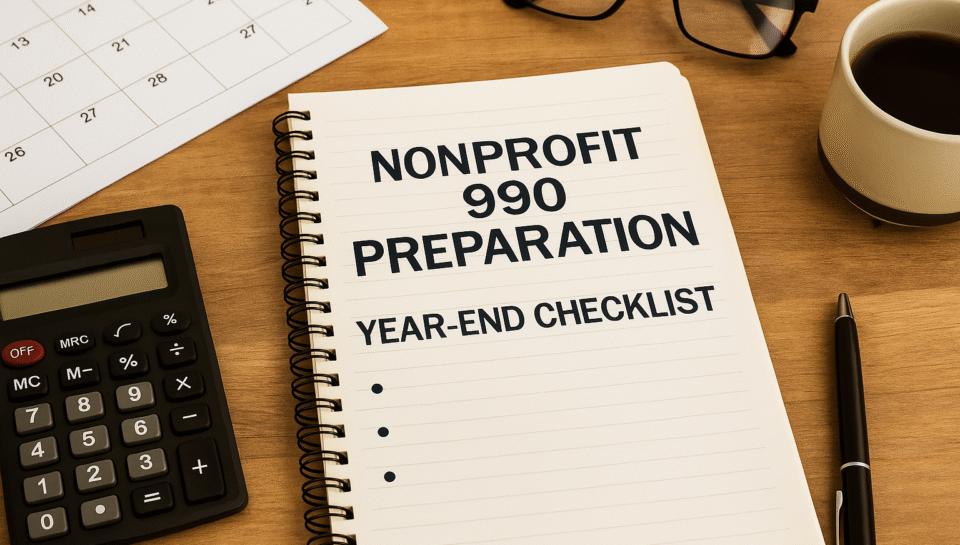

Is Your Nonprofit Ready for 990 Season? Your Last-Minute Year-End Accounting Checklist
Nonprofit 990 preparation is not something you want to scramble through in March — but that’s exactly where many organizations find themselves every year. GivingTuesday is over, year-end fundraising is in full swing, and suddenly leaders realize:
“We still need to close the books… and 990 season is right around the corner.”
The truth is, Form 990 isn’t just a tax form — it’s a public-facing document, a donor trust-builder, a grantmaker credibility check, and one of the most important compliance filings your organization submits all year.
And because December is when many nonprofits finally notice gaps in their financials, this is the perfect moment to get ahead of the stress. Below is a practical, year-end checklist to help you prepare your books, clean your data, and step into 2026 with confidence.
Why Financial Readiness Matters for Nonprofit 990 Preparation
Before diving into year-end tasks, it helps to acknowledge why Form 990 feels overwhelming. It exposes the quality of your financial records instantly. Nonprofit leaders often feel pressure because:
- Their books aren’t fully reconciled
- Donor records don’t match accounting records
- Restricted funds aren’t tracked accurately
- In-kind gifts weren’t recorded properly
- Documentation is scattered across emails and folders
- Auditors, grantors, and the board expect timely, accurate reporting
It’s not just a compliance issue — it’s a credibility issue.
75% of organizations don’t trust the accuracy of their most recent financial close, and 78% had to reopen the books to fix errors. That’s time lost and stress gained — exactly what you want to avoid heading into 990 season.
Step 1 — Clean Up Your Books Before December 31
The most important part of nonprofit 990 preparation happens before you ever touch the form itself. Clean books are the foundation of a clean filing.
Here’s what to complete now:
- Reconcile all bank, credit card, and PayPal accounts
- Match donor records to accounting records
- Review coding for accuracy (program, admin, fundraising)
- Verify restricted and unrestricted fund balances
- Record all in-kind donations
- Remove duplicate or inactive vendors
When your books tell the truth clearly, everything that follows becomes easier.
Step 2 — Organize Documentation for Easy Form 990 Filing
Form 990 requires more than numbers. Your accountant will need supporting documentation, explanations, and governance detail.
Use this documentation checklist:
- Board meeting minutes for the fiscal year
- Executive and key staff compensation details
- Governance policies (conflict of interest, whistleblower, document retention)
- Fundraising and event summaries
- Grantmaking records and criteria
- Functional expense allocation support
- Related-party transaction details
- Updated list of board members and officers
December is the ideal time to pull everything into one shared folder to avoid delays later.
Step 3 — Review Your Financial Statements for Accuracy
Your core financial statements must be accurate and complete before preparing Form 990.
Statement of Financial Position
Verify cash, receivables, payables, fixed assets, and liabilities.
Statement of Activities
Confirm revenue categories, contributions, grants, and in-kind gifts.
Statement of Functional Expenses
Ensure program, admin, and fundraising allocations are applied consistently.
Cash Flow Statement
Check that operating, investing, and financing activities are categorized correctly.
How Nonprofit 990 Preparation Protects Your Organization
Proper preparation prevents:
- IRS penalties
- Donor confidence issues
- Delayed grants
- Audit risk
- Board frustration
- Staff burnout
Nonprofits that prepare early appear more credible and well-governed — exactly what donors and funders want to see.
Step 4 — Prepare Notes, Disclosures, and Allocations
Prepare or update:
- Your mission statement and program accomplishments
- Governance descriptions
- Allocation methodology for shared expenses
- Policies and procedures
- Major donor and grant disclosures
- Narratives explaining financial changes
These disclosures help tell the story behind your numbers and strengthen transparency.
Step 5 — Confirm 990 Deadlines and Filing Requirements
To avoid penalties and stress:
Form 990 is due on the 15th day of the 5th month after your fiscal year ends.
Examples:
- Fiscal year ends Dec 31 → 990 due May 15
- Fiscal year ends Jun 30 → 990 due Nov 15
If more time is needed, file Form 8868 for an automatic extension.
Early filing signals strong governance to donors, funders, and your board.
How Outsourced Accounting Simplifies Nonprofit 990 Preparation
December is the busiest time of year for nonprofit teams. Outsourced accounting provides:
- Accurate, audit-ready books
- Clean restricted fund tracking
- Proper functional expense allocations
- Organized documentation
- Monthly reporting to prevent surprises
- Support for your CPA or 990 preparer
At Non-Profit Books, we help nonprofits move from overwhelm to clarity — with bookkeeping cleanup, monthly accounting, donor reporting, and 990-ready books.
You don’t have to carry this alone.
Conclusion — Finish the Year Strong with Confident 990 Preparation
When it comes to nonprofit 990 preparation, the biggest mistake leaders make is waiting too long. But there’s still time to clean up your books, organize your documentation, and prepare for a smooth, confident filing season.
Your mission deserves financial clarity — and your donors expect it.
👉 Schedule a free consultation. Let’s get your books 990-ready and your nonprofit positioned for a strong start to 2026.

20 Comments
vvjlorg
December 24, 2025, at 6:30 pmYo, just checked out vvjlorg! Not gonna lie, things seem pretty solid. Layout’s clean, and it’s easy to navigate. Seems like a decent spot if you’re looking for something new. Check it out for yourself: vvjlorg
one_lkEl
January 04, 2026, at 1:21 amone price [url=oneprice.shop]https://oneprice.shop/[/url]
http://m.adlf.jp/jump.php?l=http://oneprice.shop
Williampen
January 10, 2026, at 5:12 am[url=https://rhsolutions1.in]Купить пластиковые окна на заказ в Москве[/url] — это отличный способ улучшить энергоэффективность вашего дома и повысить его комфорт.
Эти окна гарантируют высокий уровень звукоизоляции и защиты от холода.
WilliamImpom
January 20, 2026, at 7:24 amVertyowdiwjodko kofkosfjwgojfsjf oijwfwsfjowehgewjiofwj jewfkwkfdoeguhrfkadwknfew ijedkaoaswnfeugjfkadcajsfn non-profitbooks.com
ritualnye_xesl
February 05, 2026, at 7:29 pmКогда сталкиваешься с утратой близкого человека, важно найти надежную ритуальные агентства минска, которая поможет организовать достойное прощание.
Необходимо проявить особое внимание и рассмотрения большого числа аспектов. В белорусской столице работает немало организаций, предлагающих ритуальные услуги, но выбор надежного партнера – может оказаться сложной задачей.
Необходимо знать, что стоимость ритуальных услуг подвержена колебаниям. На цену влияют выбранные ритуальные принадлежности, затраты на перевозку и иные параметры. Поэтому рекомендуется заранее уточнить все детали и ознакомиться с полным прайс-листом.
Выбор ритуального агентства: на что обратить внимание
Выбирая похоронное бюро важно обратить внимание на репутацию компании. Ознакомьтесь с мнениями людей, пообщайтесь с сотрудниками, чтобы сформировать личное мнение. Наличие лицензии и сертификатов также имеет немаловажное значение.
Проверьте, что агентство предоставляет полный спектр услуг, а также помощь в получении свидетельств. Наличие собственного транспорта и специального зала для отпевания – несомненные плюсы.
Оформление документов и организация церемонии
Подготовка нужных бумаг – обязательный этап организации похорон. Похоронная служба. процесс организации похорон.
Организация церемонии прощания – важный этап, позволяющий достойно проводить усопшего. Решение о выборе кладбища и зависят от пожеланий.
Дополнительные услуги и поддержка
Помимо основных услуг ритуальные агентства могут предложить дополнительные услуги, например, организацию поминок. Психологическая поддержка также оказывается востребованной.
Следует знать, что проведение погребения – является делом личным. Выбирайте агентстве, наиболее широкий перечень услуг и окажет необходимую поддержку.
**Спин-шаблон:**
“`
Организация похорон – сложный и деликатный процесс. и внимания ко многим деталям. В Минске представлен широкий спектр фирм, предлагающих ритуальные услуги, однако выбор проверенного исполнителя – может быть непростым делом.
Необходимо знать, что стоимость ритуальных услуг подвержена колебаниям. Определяют стоимость выбранные ритуальные принадлежности, затраты на перевозку и иные параметры. В связи с этим советуем заранее уточнить все детали и ознакомиться с полным прайс-листом.
Выбирая похоронное бюро важно обратить внимание на ее положение на рынке. Просмотрите комментарии клиентов, посетите офис, чтобы получить представление о работе. Лицензирование деятельности и сертификация услуг также играет существенную роль.
Удостоверьтесь, что агентство предлагает комплексное обслуживание, а также помощь в получении свидетельств. Автомобили в собственности и ритуального зала для прощания – несомненные плюсы.
Оформление документов и организация церемонии – обязательный этап организации похорон. Похоронная служба. Это существенно снизит.
Проведение траурного мероприятия – значимый момент, дающий возможность почтить память умершего. Определение места захоронения и близких и родных.
Помимо основных услуг ритуальные агентства часто предлагают дополнительные услуги, в частности, проведение поминальной трапезы. Консультации психолога также в трудный период.
Следует знать, что похоронный процесс – это индивидуальный процесс. Выбирайте агентстве, максимально полный комплекс услуг и окажет необходимую поддержку.
“`
pt888vip
February 08, 2026, at 3:45 pm玩pt888vip也有些日子了,小赢过几次,也小亏过几次,总的来说体验还行,就当是娱乐了,别太上头就好。点击看看pt888vip。
hq88top
February 08, 2026, at 3:45 pmHQ88top, eh? Gave it a shot, and I gotta say, it’s not bad! The graphics are pretty sharp, and the gameplay’s pretty solid. Definitely worth a try if you’re lookin’ for somethin’ new. hq88top
okvip13win
February 08, 2026, at 3:46 pmOkvip13win… Yeah, I remember tryin’ that one. Had a good vibe, good potential for some decent wins. Worth throwin’ a few bucks at it, see if your luck’s in. okvip13win
1bbet
February 16, 2026, at 11:40 amOpa, tudo bem? Quer saber mais sobre a 1bbet? Corre lá no site deles! Lá você encontra tudo que precisa pra começar a apostar e se divertir. Boa sorte nas apostas! 1bbet
welcometos666
February 16, 2026, at 11:41 amE aí, curiosos! Se tão dando uma olhada no Welcometos666, entrem no site e descubram o que tá rolando por lá! Parece que tem algo interessante esperando por vocês. Não percam tempo! welcometos666
link188betmoinhat
February 16, 2026, at 11:41 amAlright, mate! Looking for the freshest 188bet link? Check it out here: link188betmoinhat. Game on!
33win68com
February 26, 2026, at 4:04 amSpotted 33win68com the other day. Honestly, it’s not amazing, but it does what it says on the tin. Decent enough to throw some bets on. See for yourself: 33win68com
555ugbet
February 26, 2026, at 4:05 amDecided to see what 555ugbet was all about. Simple site, easy to use. Nothing crazy, just straightforward betting. Give 555ugbet a look if that’s your thing.
8899winlogin
February 26, 2026, at 4:05 amTook a look at 8899winlogin. Not bad! Nice and easy to play. I’d recommend giving it a whirl to any fans of the game!8899winlogin
r7bets
February 28, 2026, at 11:38 amBeen messing around r7bets lately and its pretty good. The whole experience is intuitive. I’m not saying its the best but its sure up there! See if r7bets works for you via r7bets
82jlcom
February 28, 2026, at 11:38 amJust checked out 82jlcom It’s got some interesting stuff happening I’m definitely keeping an eye on 82jlcom
ebingo
February 28, 2026, at 11:39 amBingopluscom eh? Had a flutter on ebingo there yesterday Pretty slick setup I think I’ll be back ebingo
fill777login
March 18, 2026, at 1:31 pmAlright alright, fill777login, you got my attention! Heard some good things, gonna check it out and see if it lives up to the hype. If it’s got the slots I love and a decent bonus, you’ll be hearing from me again! Check it out yourself at fill777login.
mk88club
March 18, 2026, at 1:32 pmMK88club, hmm, sounds exclusive! I’m hoping for some awesome tournaments and a killer VIP program. Let’s see if you’re worth the membership! Check it out mk88club.
mwbet88
March 18, 2026, at 1:32 pmMWbet88, I’m looking for a reliable and trustworthy platform. Fast payouts are a MUST! Don’t let me down! Try to win big at mwbet88.