
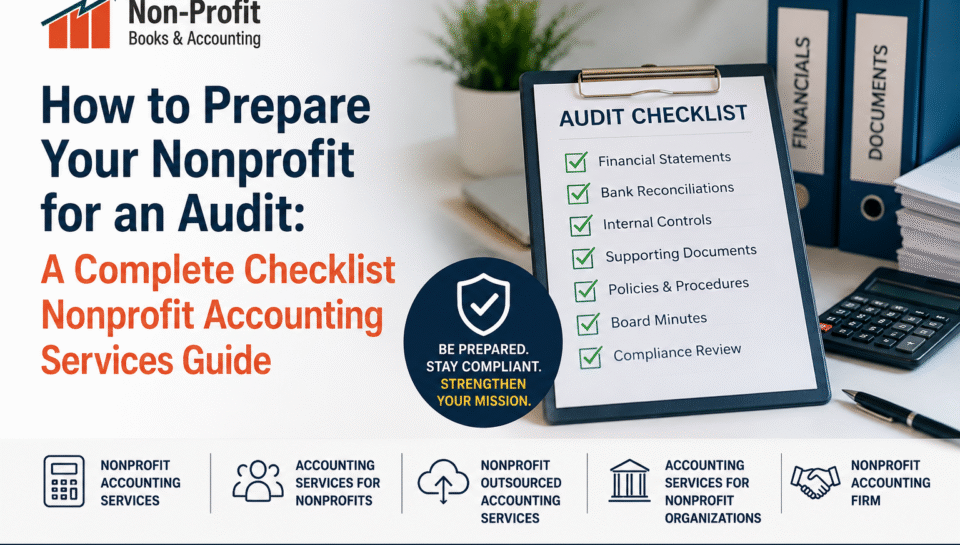

.Few phrases make a nonprofit’s finance team more anxious than “it’s audit season.” Whether it’s mandated by your state, required by a grant agreement, or requested by your board, an annual audit is a major undertaking. But it doesn’t have to be a scramble.
With the right preparation and the right support from professional nonprofit accounting services an audit can go from a stressful fire drill to a smooth, even reassuring, process. A well-prepared audit doesn’t just satisfy auditors; it demonstrates to donors, grantors, and board members that your organization is financially sound and trustworthy.
This complete checklist walks you through exactly how to prepare your nonprofit for an audit, step by step, so you can walk into audit season with confidence instead of dread.
Why Nonprofit Audits Matter More Than You Think
Before diving into the checklist, it’s worth understanding why audits carry so much weight for mission-driven organizations. Unlike for-profit businesses, nonprofits operate under intense public scrutiny. Donors want to know their contributions are used responsibly. Grantors often require audited financials before releasing funds. State attorneys general and the IRS may also review your Form 990 and supporting documentation.
An audit isn’t just a compliance checkbox it’s a credibility statement. A clean audit report signals that your organization has strong internal controls, accurate books, and responsible leadership. That’s why many organizations choose to partner with a dedicated nonprofit accounting firm rather than handling audit prep entirely in-house. Specialized expertise can mean the difference between a stressful audit and a seamless one.
Step 1: Understand What Type of Audit You Need
Not all nonprofit audits are the same. Before you prepare, confirm exactly what’s required:
- Financial statement audit – An independent review of your financial statements to ensure they’re presented fairly and in accordance with Generally Accepted Accounting Principles (GAAP).
- Single audit (Uniform Guidance audit) – Required if your organization spent $750,000 or more in federal funds during the fiscal year.
- Compliance audit – Focused on whether you followed the specific terms of grants or contracts.
- Internal audit – A voluntary, internally driven review used to strengthen controls before an external audit occurs.
Knowing which type applies to your organization shapes everything else on this checklist, from the documents you gather to the timeline you set.
Step 2: Choose the Right Auditor (and the Right Accounting Partner)
Selecting an independent, qualified auditor is critical. Look for a CPA firm with specific experience auditing nonprofit organizations, since nonprofit accounting involves unique rules around fund accounting, restricted vs. unrestricted revenue, and functional expense reporting.
This is also where many organizations lean on accounting services for nonprofits to bridge the gap between their internal bookkeeping and the auditor’s expectations. A knowledgeable accounting partner can help you interview and select an auditor, negotiate audit fees, and set a realistic timeline that doesn’t overwhelm your staff.
Step 3: Start Early Build an Audit Timeline
The single biggest predictor of audit stress is how early you start preparing. Ideally, audit prep should begin two to three months before your auditors arrive. Build a simple internal calendar covering:
- Document collection deadlines
- Internal review and reconciliation dates
- Board committee check-ins
- The auditor’s fieldwork dates
- Draft report review and final sign-off
Organizations that outsource their books to a nonprofit outsourced accounting services provider often find this step significantly easier, since monthly reconciliations and clean records are already in place year-round rather than needing to be reconstructed under time pressure.
Step 4: The Complete Nonprofit Audit Preparation Checklist
Here’s the core checklist your team or your outsourced accounting partner should work through before auditors arrive.
Financial Records
- Reconciled bank and credit card statements for every month of the fiscal year
- General ledger detail matching the trial balance
- Reconciliation of accounts receivable and accounts payable
- Fixed asset register with depreciation schedules
- Investment account statements and reconciliations
- Payroll records, including tax filings (941s, W-2s, W-3)
Revenue and Contributions
- Donor contribution records, including restricted vs. unrestricted designations
- Grant agreements and related correspondence
- Pledge receivables and their collectability assessments
- In-kind donation documentation and valuations
- Special event revenue and expense summaries
Expenses
- Functional expense allocation methodology (program, management/general, fundraising)
- Vendor invoices and supporting documentation for major expenditures
- Travel and expense reimbursement policies and records
- Grant expenditure reports tied to specific funding sources
Governance and Compliance Documents
- Board meeting minutes for the full fiscal year
- Conflict of interest policy and signed disclosures
- Bylaws and any amendments
- Prior year’s audit report and management letter
- Form 990 from the previous year
- Insurance policies (general liability, D&O, cyber)
Internal Controls Documentation
- Written policies for cash handling, purchasing approvals, and expense authorization
- Segregation of duties documentation
- Whistleblower and document retention policies
Having every one of these items organized, labeled, and easily accessible drastically reduces the number of follow-up questions and follow-up delays during fieldwork.
Step 5: Reconcile Everything Before the Auditors Arrive
One of the most common mistakes nonprofits make is handing auditors unreconciled books and hoping the audit process will “sort it out.” That approach wastes valuable (and expensive) audit hours and increases the likelihood of findings.
Before fieldwork begins, make sure:
- Every bank and investment account is reconciled to the general ledger
- Restricted and unrestricted net assets are properly classified
- Interfund transfers are documented and balanced
- Payroll liabilities match payroll tax filings
- All revenue has been recorded in the correct fiscal period
This is precisely the kind of ongoing discipline that accounting services for nonprofit organizations are built to provide. When your books are reconciled monthly rather than scrambled together at year-end, audit prep becomes a matter of organizing existing accurate data rather than reconstructing an entire year of transactions from scratch.
Step 6: Prepare a Draft Financial Statement Package
Many auditors expect the organization to provide a draft set of financial statements, including:
- Statement of Financial Position (balance sheet)
- Statement of Activities (income statement)
- Statement of Functional Expenses
- Statement of Cash Flows
- Notes to the financial statements
Preparing these in advance, in the correct nonprofit format, shows auditors that your organization understands its own financial position and significantly speeds up the review process.
Step 7: Assign an Internal Point Person
Designate one staff member typically your finance director, controller, or outsourced accounting lead as the single point of contact for the auditors. This person should:
- Know where every document lives
- Be available to answer questions quickly during fieldwork
- Coordinate between the auditors, program staff, and leadership
- Track open items and follow up promptly
Having one clear point of contact prevents miscommunication and keeps the audit moving on schedule.
Step 8: Prepare Your Board and Staff
Your board’s audit committee (or full board, if you don’t have a dedicated committee) should be briefed before, during, and after the audit. Schedule a pre-audit meeting to review expectations, and plan a post-audit meeting where the auditor presents findings directly to the board.
Staff across departments especially program managers who handle grant-funded activities should also understand what documentation they may be asked to provide, particularly around grant compliance and expense allocation.
Step 9: Review Prior Year Findings and Management Letters
If your organization received a management letter or any findings in a previous audit, address those issues before this year’s fieldwork begins. Auditors will specifically check whether prior recommendations were implemented. Demonstrating proactive follow-through on past findings builds auditor confidence and often results in a smoother, faster audit.
Step 10: Conduct a Mock Internal Review
If time and resources allow, consider a mock audit or internal review a few weeks before the real thing. This is where working with a specialized nonprofit accounting firm pays real dividends an experienced outside team can catch inconsistencies, missing documentation, or classification errors before your official auditors do, giving you time to correct them without the pressure of a live audit.
Common Audit Pitfalls to Avoid
Even well-intentioned nonprofits run into the same recurring issues each audit season:
- Misclassifying restricted funds as unrestricted (or vice versa)
- Inconsistent functional expense allocations from year to year
- Missing grant compliance documentation required by funders
- Unreconciled accounts left until the last minute
- Poor segregation of duties, especially in small finance teams
- Outdated or missing board minutes approving major financial decisions
Avoiding these pitfalls comes down to consistent, accurate bookkeeping practices maintained throughout the year not just during the weeks before an audit.
Why Outsourcing Audit Prep Makes Sense for Many Nonprofits
Many small and mid-sized nonprofits simply don’t have a large enough finance team to handle both day-to-day operations and intensive audit preparation. That’s where outsourcing becomes a strategic advantage rather than a luxury.
Partnering with dedicated nonprofit accounting services gives your organization access to:
- Monthly reconciliations and clean books maintained year-round
- Staff who understand nonprofit-specific accounting standards (ASC 958, functional expense reporting, restricted fund accounting)
- Experienced guidance through the entire audit lifecycle, from auditor selection to final report review
- Reduced risk of costly errors or audit findings
- More time for your team to focus on mission-driven work instead of spreadsheets
This is exactly the kind of support Non-Profit Books provides. As a firm built specifically around the needs of mission-driven organizations, Non-Profit Books helps nonprofits maintain audit-ready financials all year long not just in the weeks before fieldwork begins. From monthly bookkeeping to full audit preparation support, Non-Profit Books acts as an extension of your internal team, so audit season becomes routine rather than stressful.
Final Thoughts: Turn Audit Season Into an Opportunity
An audit doesn’t have to be something your nonprofit dreads every year. With early preparation, organized documentation, reconciled books, and the right support, it can actually become an opportunity a chance to demonstrate financial stewardship to your board, funders, and community.
Whether you manage your books internally or rely on outsourced support, the key is consistency. Organizations that treat “audit readiness” as a year-round habit, rather than a once-a-year scramble, consistently experience shorter, smoother, and less costly audits.
If your team is feeling stretched thin, partnering with a firm that specializes in nonprofit outsourced accounting services can transform the way your organization approaches audits. With the right nonprofit accounting partner by your side, you won’t just survive audit season you’ll walk out of it with a stronger, more resilient organization.
Ready to make audit prep effortless? Non-Profit Books specializes in helping nonprofits stay organized, compliant, and audit-ready all year long. Reach out today to learn how dedicated accounting services for nonprofit organizations can take the stress out of your next audit.