
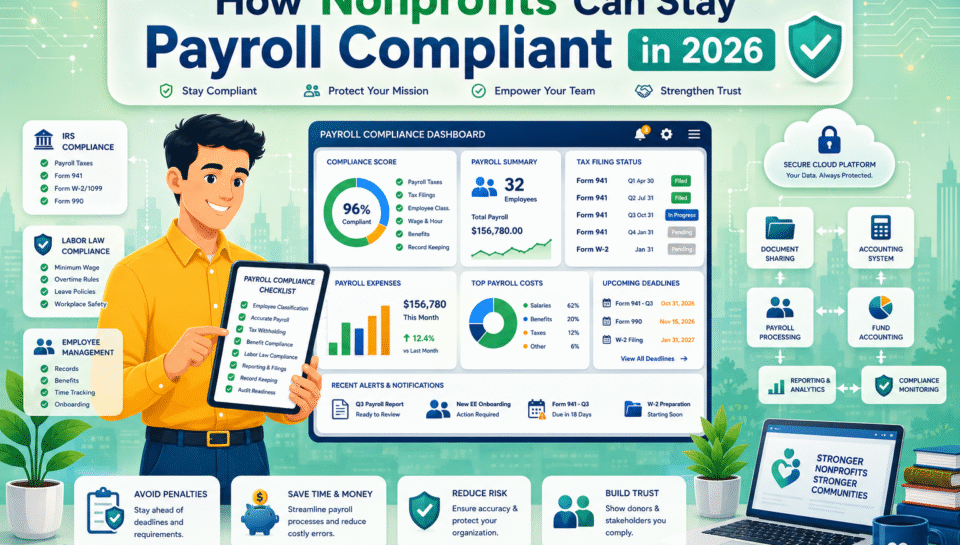

Running payroll for a nonprofit is not the same job as running payroll for a typical small business. The math is more complicated, the stakes are higher, and the audience watching is bigger donors, grantors, state regulators, the IRS, and your own board all have a reason to care whether your organization pays its people correctly and reports that pay accurately.
2026 has already brought a wave of state minimum wage increases, shifting overtime salary thresholds, and renewed attention to how compensation gets disclosed on Form 990. For mission-driven organizations trying to stretch every dollar, staying on top of all of it without dedicated nonprofit payroll services or experienced nonprofit accounting services is harder than ever.
This guide breaks down what’s changed, where nonprofits most often get tripped up, and how a partner like Non-Profit Books can help your organization stay compliant while keeping its focus on mission, not paperwork.
Why Payroll Compliance Looks Different for Nonprofits
For-profit businesses run payroll against revenue. Nonprofits run payroll against restricted revenue grants with reporting requirements, donor-restricted gifts, and program budgets that often have to show exactly how labor dollars were spent. That single difference touches almost everything else:
- Funder accountability. Grant agreements frequently require organizations to track staff time by program or funding source, not just by department.
- Public disclosure. Compensation for officers, directors, and key employees is reported on Form 990, which is a public document anyone can pull up online.
- Board oversight. Nonprofit boards carry fiduciary responsibility for financial controls, including payroll, even though most board members aren’t payroll experts.
- Mixed workforces. Many nonprofits combine full-time staff, part-time program workers, seasonal employees, independent contractors, and volunteers each governed by different wage and hour rules.
This is why generic small-business payroll software often falls short. Nonprofits need payroll for nonprofits that’s built around fund accounting logic, not just gross pay and tax withholding.
Key 2026 Payroll Compliance Changes Nonprofits Need to Watch
State minimum wage increases
A large number of states adjusted their minimum wage rates at the start of 2026, with additional increases scheduled for mid-year in several states and localities. For nonprofits with hourly program staff, direct service workers, or part-time employees across multiple states, even a modest per-hour increase can ripple through budgets, grant allocations, and overtime calculations. Organizations operating in more than one state need a process for tracking these changes by jurisdiction, not just at the state level many cities and counties set their own, higher minimums.
Exempt salary thresholds are diverging by state
At the federal level, the minimum salary required for an employee to qualify as exempt under the Fair Labor Standards Act’s executive, administrative, and professional exemptions remained unchanged in 2026. Earlier in 2024, a rule had been issued to raise that federal threshold substantially, but it was struck down in court, and in 2026 the Department of Labor formally restored the lower, pre-2024 salary level as the governing federal standard.
States, however, are not standing still. Several states including California, Colorado, New York, and Washington raised their own minimum salary thresholds for exempt employees in 2026, and some of those state thresholds now sit well above the federal number. Because employers generally have to follow whichever standard is more protective of the employee, a nonprofit with exempt staff in one of these states may need to either raise salaries or reclassify roles as non-exempt and start tracking hours and paying overtime.
The nonprofit-specific FLSA carve-outs still matter
Charitable nonprofits are not automatically treated as “covered enterprises” under the FLSA the way most businesses are. Coverage generally only kicks in if the organization generates at least a set amount of revenue from genuinely commercial activity, such as a gift shop or fee-based services. This doesn’t mean nonprofit employees have no wage protections many are still individually covered but it does mean classification decisions require a closer look than simply applying the rules a for-profit competitor would follow. The volunteer-versus-employee line is just as important: paid staff generally cannot “volunteer” extra hours doing the same work they’re employed to do, and treating that time as unpaid can create real liability.
New tax treatment of tips and overtime
Recent federal tax legislation introduced a new exemption for certain “qualified” tips and overtime pay. Nonprofits that operate fee-based programs, social enterprises, or hospitality-adjacent services and pay any tipped or overtime-eligible staff should understand how this affects payroll tax reporting, even if it doesn’t change what employees are owed under wage and hour law.
Form 990 and Payroll: The Connection You Can’t Ignore
Payroll data doesn’t stay in the payroll system it flows directly into your Form 990 preparation services process every year. Compensation for officers, key employees, and the five highest-paid employees over a certain threshold has to be reported, often with additional detail required on Schedule J for highly compensated individuals. Sloppy payroll records during the year mean a scramble or worse, inaccurate disclosures at filing time.
A few 990 deadline basics worth keeping on your calendar for 2026:
- For calendar-year organizations, Form 990 is due May 15, 2026.
- A single automatic six-month extension is available by filing Form 8868 on or before the original due date, pushing the deadline into mid-November 2026.
- Organizations with gross receipts of $50,000 or less generally file the simpler Form 990-N; those under $200,000 in receipts and $500,000 in assets may qualify for Form 990-EZ; larger organizations file the full Form 990.
- Missing the filing requirement for three consecutive years triggers automatic revocation of tax-exempt status a consequence the IRS does not reverse lightly.
Because the form is public and frequently reviewed by donors, watchdog sites, and grant committees, accurate compensation reporting is also a trust issue, not just a tax issue. Clean, well-documented payroll throughout the year is what makes 990 season manageable instead of chaotic.
Fund Accounting: Where Payroll Meets Restricted Grants
For grant-funded organizations, labor is usually the single largest line item in the budget which makes it the line item funders scrutinize most closely. This is where nonprofit fund accounting services become essential. Unlike standard business accounting, fund accounting requires allocating each employee’s time and cost across the correct grant, program, or restriction category, and being able to prove it.
That typically means:
- Time tracking by program, grant, or funding source not just by department
- Documented, defensible allocation methodologies for staff who split time across multiple programs
- Clear separation of billable/reimbursable labor from general operating costs
- Records that hold up under a funder audit or single audit review
Spreadsheets and informal approval processes can work for a small staff with one or two funding streams. They become a liability fast as an organization adds employees, locations, grants, or restricted funds. This is one of the main reasons nonprofits move toward dedicated nonprofit bookkeeping services built specifically around fund accounting rather than generic bookkeeping tools.
Common Payroll Compliance Pitfalls for Nonprofits
Even well-intentioned organizations run into the same handful of problems:
- Misclassifying workers. Treating someone as an independent contractor or volunteer when the relationship legally looks like employment is one of the most common and most expensive mistakes nonprofits make.
- Inconsistent exempt classifications across states. A program director classified as exempt in one state may not qualify under another state’s stricter duties test or higher salary threshold.
- Loose time allocation for grant-funded staff. Estimating rather than documenting how an employee’s hours split across programs creates exposure during funder audits.
- Multi-state payroll registration gaps. Remote and field staff working across state lines can trigger state tax withholding and unemployment insurance registration requirements that small organizations frequently overlook.
- Disconnected payroll and 990 reporting. When payroll and accounting systems don’t talk to each other, compensation disclosures on the 990 are rebuilt from scratch every year instead of pulled from clean, ongoing records.
A 2026 Payroll Compliance Checklist for Nonprofits
- Confirm minimum wage rates for every state and locality where you have employees
- Review exempt employee classifications against both federal and state salary thresholds
- Audit worker classifications: employee, contractor, and volunteer
- Verify multi-state payroll tax registrations are current for remote or field staff
- Confirm time-tracking systems can allocate labor by grant, program, or fund
- Reconcile payroll records monthly against your general ledger, not just at year-end
- Mark your Form 990 deadline and extension date on the organizational calendar
- Review board-approved compensation policies for officers and key employees
Why Outsourcing Payroll and Bookkeeping Makes Sense for Nonprofits
Most nonprofits don’t have and don’t need a full-time payroll attorney or a dedicated compliance department. What they need is a partner who already understands fund accounting, grant reporting, and the specific wage and hour rules that apply to tax-exempt organizations.
That’s the gap Non-Profit Books is built to fill. Rather than forcing your organization to adapt generic business payroll tools to nonprofit needs, Non-Profit Books combines nonprofit payroll services, nonprofit bookkeeping services, and nonprofit fund accounting services under one roof so your payroll data, your grant allocations, and your Form 990 preparation all draw from the same clean, accurate source.
Whether you’re a small organization filing a 990-N for the first time or a multi-program nonprofit juggling restricted grants across several states, the right systems and the right support make the difference between scrambling every May and having compliance handled as a matter of routine.
Final Thoughts
2026 has brought enough payroll and compliance shifts state wage increases, diverging overtime thresholds, renewed scrutiny on Form 990 disclosures that nonprofits can’t afford to treat payroll as an afterthought. The organizations that stay ahead of it are the ones that build clean systems for tracking pay, classifying workers correctly, and connecting payroll data to grant reporting and annual filings.
If your organization wants payroll and bookkeeping handled by people who actually understand nonprofit fund accounting, Form 990 preparation, and the wage and hour rules unique to tax-exempt organizations, Non-Profit Books is here to help you build that foundation so your team can stay focused on mission, not compliance headaches.