
Running a nonprofit means juggling a mission-driven purpose with the very real, very technical demands of financial management. Unlike for-profit businesses that track a single bottom line, nonprofits must account for multiple funding sources, restricted grants, donor requirements, and board reporting obligations all at once. This is where dedicated fund accounting services become essential, not optional.
At Non-Profit Books, we work with organizations every day that are struggling to keep up with donor restrictions, grant deadlines, and audit requirements using generic bookkeeping tools or spreadsheets never designed for the job. In this guide, we’ll break down what fund accounting actually is, why it’s different from standard accounting, and how the right combination of non profit fund accounting, grant tracking services, and grant management services can transform how your organization operates.
What Is Fund Accounting, and Why Do Nonprofits Need It?
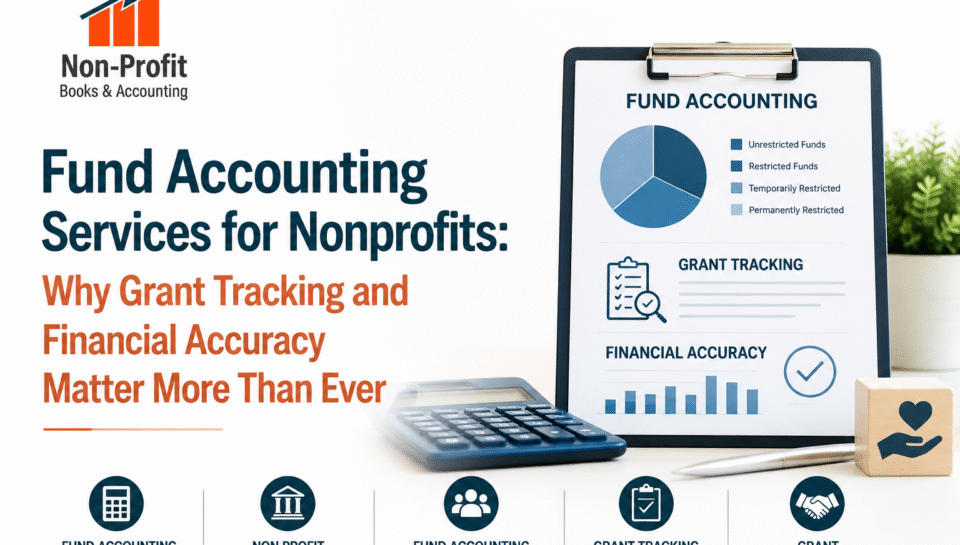
Fund accounting is a system of accounting designed specifically for organizations like nonprofits, government agencies, and churches that need to track how money is used rather than simply how much profit is made. Instead of one general ledger, fund accounting divides financial resources into separate “funds,” each representing a specific purpose, program, or donor restriction.
For example, a nonprofit might manage:
- An unrestricted general operating fund
- A restricted fund for a specific grant-funded program
- A capital campaign fund for a building project
- A scholarship fund tied to donor-designated gifts
Each of these funds must be tracked separately to ensure the organization is spending money exactly as promised to donors, grantors, and regulators. This is the core difference between standard business accounting and fund accounting for nonprofits accountability to purpose, not just profitability.
Without a proper system in place, it becomes incredibly easy to accidentally commingle funds, misreport program expenses, or lose track of which dollars are still restricted. That’s not just a bookkeeping headache it can jeopardize future funding, trigger audit findings, or damage donor trust.
The Real Cost of Getting Fund Accounting Wrong
Many small and mid-sized nonprofits start out managing their books with basic accounting software or in-house staff wearing multiple hats. While this can work temporarily, problems tend to surface quickly:
- Misallocated expenses — Costs get charged to the wrong fund or grant, creating inaccurate financial reports.
- Compliance risk — Grantors and auditors expect precise fund-level reporting; errors can result in findings, repayment demands, or loss of future funding.
- Board and donor distrust — Inconsistent or delayed financial reports erode confidence from your board, major donors, and funding partners.
- Wasted staff time — Executive directors and program staff often end up doing manual reconciliation work that pulls them away from mission-critical activities.
This is exactly why more organizations are turning to specialized fund accounting services rather than trying to manage everything internally with limited financial expertise.
Why Non-Profit Books Specializes in Fund Accounting for Nonprofits
At Non-Profit Books, our entire practice is built around the unique financial needs of mission-driven organizations. We don’t treat nonprofit clients like small businesses with a different tax status we understand that non profit fund accounting requires an entirely different framework, reporting structure, and level of donor accountability.
Our approach to fund accounting for nonprofits includes:
- Fund-level bookkeeping that separates restricted, temporarily restricted, and unrestricted funds according to GAAP and FASB nonprofit accounting standards
- Program-based expense allocation so you always know the true cost of running each initiative
- Monthly financial statements built specifically for nonprofit boards, including Statement of Financial Position and Statement of Activities
- Audit-ready records that make annual audits and 990 filings smoother and faster
- Cloud-based systems that give your leadership real-time visibility into financial health
By partnering with a firm that lives and breathes nonprofit finance, organizations avoid the trial-and-error of learning fund accounting on the fly and gain a financial partner who already understands the compliance landscape.
The Growing Importance of Grant Tracking Services
Grants are often a nonprofit’s largest and most complex source of revenue. Each grant typically comes with its own budget, reporting schedule, allowable expense categories, and drawdown requirements. Managing even a handful of active grants without a dedicated system can quickly spiral into confusion.
This is where professional grant tracking services come in. Effective grant tracking means:
- Recording every grant’s budget, restrictions, and reporting deadlines in one centralized system
- Tracking expenses against each grant in real time, not just at year-end
- Flagging under-spending or over-spending before it becomes a compliance issue
- Generating grant-specific financial reports quickly when funders request them
- Maintaining a clear audit trail for every dollar drawn down or spent
Without accurate grant tracking, organizations risk missing reimbursement deadlines, misreporting expenditures, or worse losing eligibility for future funding because of a poor compliance track record. Funders want to see that their money is being used exactly as intended, and they want documentation to prove it.
How Grant Management Services Go Beyond Basic Tracking
While grant tracking focuses on the financial mechanics, comprehensive grant management services take a broader view of the entire grant lifecycle. This includes:
- Pre-award budgeting — building realistic, fundable budgets before a grant is even awarded
- Post-award compliance — ensuring spending stays within approved categories and timelines
- Reporting coordination — preparing narrative and financial reports for funders on schedule
- Multi-grant oversight — managing overlapping grant periods and blended funding sources without confusion
- Indirect cost rate calculations — ensuring your organization is recovering appropriate overhead costs
When grant tracking and grant management work together as part of a broader fund accounting system, nonprofits gain a complete picture of their funding health not just isolated numbers in a spreadsheet.
Signs Your Nonprofit Needs Professional Fund Accounting Support
Not sure if it’s time to bring in outside help? Consider these common warning signs:
- Your board or funders have raised questions about financial reports you couldn’t fully answer
- You’re spending hours each month manually reconciling grant spending
- Your organization has grown to manage multiple grants or restricted funds simultaneously
- You’ve had audit findings related to fund allocation or expense classification
- Your executive director or program staff are doing accounting tasks instead of focusing on mission work
- You don’t have real-time visibility into how much of each grant has been spent
If any of these sound familiar, it’s a strong indication that your organization would benefit from dedicated fund accounting services rather than continuing to manage finances reactively.
What to Look for in a Fund Accounting Partner
Not all accounting firms understand the nuances of nonprofit finance. When evaluating a partner for non profit fund accounting, grant tracking, or grant management services, look for:
- Nonprofit-specific experience — Ask how many nonprofit clients they currently serve and in what sectors.
- Knowledge of FASB nonprofit standards — Your accounting partner should be fluent in restricted vs. unrestricted fund reporting.
- Grant compliance expertise — They should understand federal, state, and private funder requirements, including indirect cost rate agreements.
- Transparent reporting — You should receive clear, board-ready financial statements every month, not just at tax time.
- Scalability — As your organization grows and takes on more grants, your accounting partner should be able to scale with you.
This is precisely the standard Non-Profit Books holds itself to with every client relationship because nonprofits deserve financial partners who understand their mission, not just their tax form.
Bringing It All Together
Fund accounting isn’t just a back-office function it’s the financial infrastructure that protects your nonprofit’s credibility, funding relationships, and long-term sustainability. From properly separating restricted and unrestricted funds to maintaining airtight grant tracking systems, the details matter enormously in the nonprofit sector.
Organizations that invest in specialized fund accounting for nonprofits save themselves from costly errors, strengthen relationships with funders, and free up leadership to focus on what matters most: their mission.
At Non-Profit Books, we specialize in exactly this kind of support combining non profit fund accounting, grant tracking services, and comprehensive grant management services into one seamless system built for mission-driven organizations. Whether you’re managing a handful of restricted funds or juggling a dozen active grants across multiple funders, having the right financial partner in place makes all the difference.
If your organization is ready to move away from spreadsheet chaos and toward accurate, audit-ready, real-time financial visibility, it may be time to talk to a team that understands nonprofit finance inside and out. Non-Profit Books is here to help your organization build the financial foundation it needs to grow with confidence.