

Running a nonprofit means juggling a dozen priorities at once fundraising, programs, donor relationships, and staffing, to name just a few. Amid all this, tax compliance can easily slip down the priority list. Yet missing a Form 990 filing deadline can trigger penalties, jeopardize your tax-exempt status, and even damage donor trust. Understanding exactly when and how to file is one of the most important administrative responsibilities a nonprofit organization has.
This guide breaks down everything you need to know about Form 990 filing deadlines, the different versions of the form, what happens if you miss a deadline, and how professional form 990 preparation services can help your organization stay compliant year after year.
What Is Form 990?
Form 990 is the annual information return that most tax-exempt organizations are required to file with the IRS. It isn’t a tax return in the traditional sense nonprofits generally don’t owe income tax but rather a transparency document. The IRS, donors, watchdog groups, and the general public use Form 990 to evaluate how a nonprofit raises and spends money, who runs it, and whether it’s operating in line with its exempt purpose.
Because Form 990 is a public document, it plays a dual role: satisfying form 990 compliance requirements while also functioning as a credibility tool. A well-prepared, accurate filing signals to funders and the public that your organization is financially responsible and transparent.
Why Form 990 Filing Deadlines Matter
Unlike many business tax deadlines that fall on a fixed calendar date, Form 990 deadlines are tied to your organization’s fiscal year. This flexibility is convenient, but it also means many nonprofits lose track of their actual due date especially smaller organizations without dedicated finance staff.
Missing your deadline isn’t just an inconvenience. The IRS imposes escalating penalties for late filings, and if an organization fails to file for three consecutive years, its tax-exempt status is automatically revoked. Reinstating exempt status after revocation is a lengthy, costly process, and in the meantime, donations made to your organization may no longer be tax-deductible.
This is why nonprofit form 990 filing should never be treated as an afterthought. Planning ahead and understanding exactly which form applies to your organization is essential to staying in good standing.
When Is Form 990 Due?
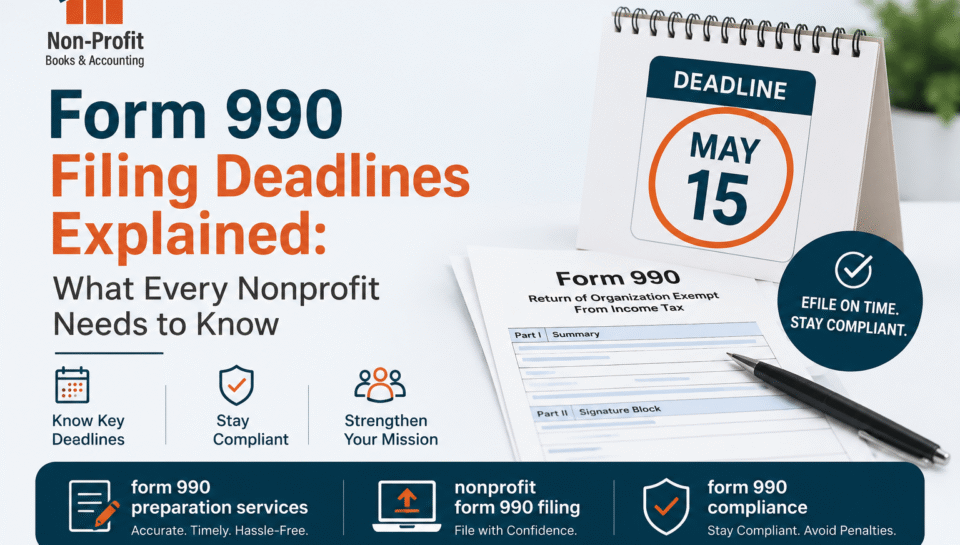
The standard rule is straightforward: Form 990 is due on the 15th day of the 5th month after the end of your organization’s fiscal year.
Here’s how that plays out in practice:
- Fiscal year ends December 31 → Filing deadline is May 15
- Fiscal year ends June 30 → Filing deadline is November 15
- Fiscal year ends September 30 → Filing deadline is February 15
If the 15th falls on a weekend or federal holiday, the deadline shifts to the next business day. Because so many nonprofits operate on a calendar year, May 15 is the most commonly recognized Form 990 deadline but organizations with different fiscal years must track their own unique due date carefully.
Extensions Are Available
If your organization needs more time, the IRS allows a single automatic six-month extension by filing Form 8868 before the original due date. For a calendar-year nonprofit, this pushes the deadline from May 15 to November 15. It’s important to note that this extension only applies to the filing itself there is no extension for any unrelated business income tax that may be owed.
Which Version of Form 990 Does Your Organization File?
Not every nonprofit files the same version of the form. The IRS uses gross receipts and total assets to determine which version applies:
Form 990-N (e-Postcard) For organizations with gross receipts normally $50,000 or less. This is a simple, eight-question online submission but it’s still legally required, and failing to file it still counts against your organization for revocation purposes.
Form 990-EZ For organizations with gross receipts under $200,000 and total assets under $500,000. This is a shortened version of the full form but still requires detailed financial reporting.
Form 990 (Full Form) Required for organizations with gross receipts of $200,000 or more, or total assets of $500,000 or more. This is the most comprehensive version, covering governance, compensation, program service accomplishments, and detailed financial statements.
Form 990-PF Required for all private foundations, regardless of financial size.
Choosing the correct version and completing it accurately is a core part of form 990 reporting. Filing the wrong version, or leaving out required schedules, can result in the IRS treating your return as incomplete, which carries the same risk as not filing at all.
Common Mistakes That Delay or Derail Filings
Even well-intentioned nonprofits run into trouble with Form 990. Some of the most frequent issues include:
Misjudging the fiscal year deadline. Organizations that changed their fiscal year or aren’t calendar-year filers sometimes miscalculate their due date entirely.
Incomplete financial records. Form 990 requires detailed breakdowns of revenue, functional expenses, and compensation. If bookkeeping wasn’t kept current throughout the year, preparation can stall right before the deadline.
Missing required schedules. Depending on your activities fundraising events, lobbying, foreign operations, or significant donor contributions additional schedules may be required. Omitting them is one of the most common reasons the IRS flags a return.
Inconsistent numbers across documents. Auditors, grant reporting, and Form 990 all need to align. Discrepancies raise red flags with both the IRS and potential funders reviewing your public filing.
DIY filing without nonprofit-specific expertise. General tax software often isn’t built with nonprofit accounting rules in mind, leading to errors in areas like functional expense allocation or net asset classification.
This is where dedicated form 990 preparation support becomes valuable not just to meet the deadline, but to ensure the return accurately represents your organization’s financial story.
What Happens If You Miss the Deadline?
The consequences of a late or missed Form 990 filing scale with the size of your organization and how long the delinquency continues:
- Daily penalties accrue for each day the return is late, with a maximum cap that depends on the organization’s gross receipts.
- Larger organizations face steeper daily penalties and higher maximum fines.
- Three consecutive years of non-filing results in automatic revocation of tax-exempt status no warning letter required.
- Reinstatement after revocation requires a new exemption application, often with retroactive reinstatement fees and, in some cases, back taxes.
Beyond financial penalties, a late or delinquent filing becomes part of the public record. Donors, grantmakers, and rating platforms like GuideStar/Candid can see filing history, and gaps or late filings may raise concerns about organizational stability.
Best Practices for Staying on Top of Form 990 Deadlines
1. Know your exact due date. Mark your fiscal year-end and calculate your Form 990 deadline immediately don’t wait until the filing season arrives.
2. Keep books current throughout the year. Waiting until the filing deadline to reconcile a full year of transactions is a recipe for errors and delays. Monthly or quarterly bookkeeping makes year-end preparation dramatically smoother.
3. Identify the correct form version early. Review your gross receipts and total assets well before your deadline so you know which version of Form 990 applies.
4. File Form 8868 proactively if you need more time. An extension is far better than a late or rushed filing.
5. Review before submitting. Cross-check your Form 990 against your audited financials, board-approved budget, and prior-year filings for consistency.
6. Work with specialists who understand nonprofit accounting. Nonprofit financial reporting has its own rules from functional expense allocation to donor restriction tracking that differ significantly from for-profit accounting.
How Non-Profit Books Can Help
At Non-Profit Books, we specialize exclusively in nonprofit financial management, including accurate, on-time form 990 preparation services tailored to organizations of every size. Whether you’re filing a straightforward 990-N e-Postcard or a full Form 990 with multiple schedules, our team understands the nuances of nonprofit accounting and form 990 compliance requirements that general accounting firms often miss.
We work with your organization throughout the year not just at deadline time to keep your books accurate and audit-ready, so form 990 reporting becomes a smooth, predictable process rather than a year-end scramble. From tracking restricted funds to allocating functional expenses correctly, our approach ensures your filing reflects your organization’s financial health accurately and favorably.
If your nonprofit needs reliable, experienced support with nonprofit form 990 filing, Non-Profit Books is here to help you meet every deadline with confidence.
Final Thoughts
Form 990 is more than a regulatory obligation it’s a reflection of your nonprofit’s transparency and financial stewardship. Understanding your filing deadline, choosing the correct form, and maintaining accurate records throughout the year are the foundation of staying compliant and building trust with donors, funders, and the public.
Don’t let a missed deadline put your tax-exempt status at risk. Partner with experienced professionals who understand the ins and outs of nonprofit compliance, and turn Form 990 season from a source of stress into a routine part of good financial governance.