
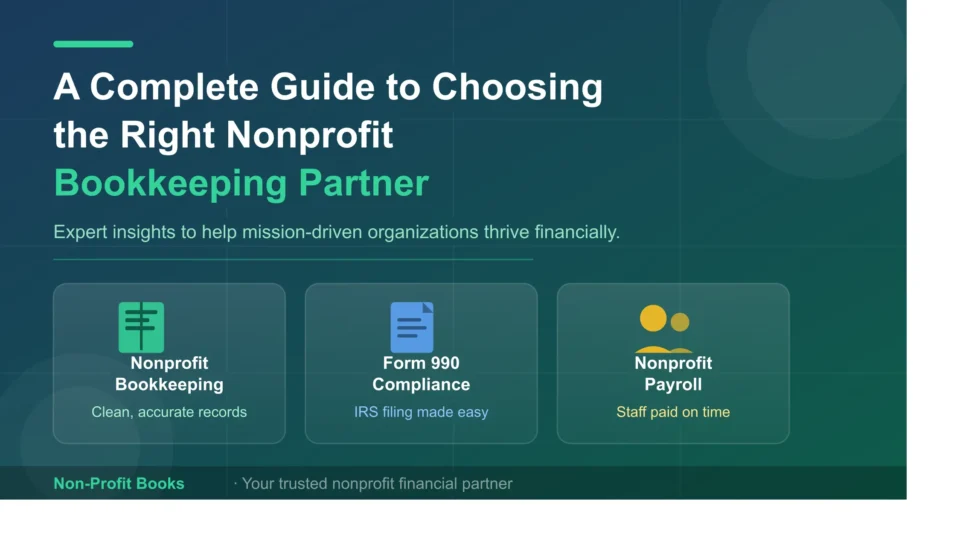

Running a nonprofit organization is a deeply rewarding endeavor, but it comes with a unique set of financial responsibilities that differ significantly from those of for-profit businesses. From maintaining donor trust to staying compliant with the IRS, every financial decision you make carries weight not just for your organization, but for the communities you serve. That is why finding the right nonprofit bookkeeping partner is one of the most important decisions a nonprofit leader can make.
This guide walks you through everything you need to know to choose the right bookkeeping partner one that understands the nonprofit world, handles your compliance obligations, and empowers your mission rather than getting in the way of it.
Why Nonprofit Bookkeeping Is Different
Before diving into how to choose a partner, it’s important to understand why nonprofits require specialized bookkeeping in the first place.
Unlike businesses that focus on profit and loss, nonprofits must track funds by restriction — separating unrestricted, temporarily restricted, and permanently restricted funds. They must manage grant reporting, demonstrate stewardship to donors, and comply with specific IRS requirements. A bookkeeper who has only worked with for-profit businesses may not understand these nuances, potentially putting your organization at risk.
Additionally, nonprofits are subject to public disclosure obligations. Your financial records are not private — they are visible to the public through your annual tax filings. Every number needs to be accurate, organized, and defensible. This is not the place for guesswork or shortcuts.
Key Qualities to Look for in a Nonprofit Bookkeeping Partner
1. Deep Expertise in the Nonprofit Sector
Not all bookkeepers are created equal. When evaluating potential partners, ask specifically about their experience working with nonprofits. Have they worked with organizations of similar size and budget to yours? Do they understand fund accounting? Are they familiar with grant tracking, restricted funds, and donor reporting?
A bookkeeping partner that specializes exclusively in nonprofits like Non-Profit Books brings a level of targeted expertise that generalist firms simply cannot match. Their systems, workflows, and knowledge base are all built around the specific challenges nonprofits face every day.
2. Comprehensive Service Offerings
A strong nonprofit bookkeeping partner should be able to handle more than just reconciling your bank statements. Look for a partner that offers a full suite of services tailored to your organization’s needs, including:
Form 990 Tax Compliance & Filing for Nonprofits
The IRS Form 990 is one of the most important documents your nonprofit will file each year. It is not just a tax form — it is a public statement of your organization’s financial health, governance practices, and program effectiveness. Errors or omissions on the Form 990 can trigger IRS scrutiny, damage donor confidence, and even threaten your tax-exempt status.
A qualified bookkeeping partner should offer end-to-end support for Form 990 Tax Compliance & Filing for Nonprofits, including gathering the financial data required, ensuring accuracy in every reported figure, and filing on time. At Non-Profit Books, Form 990 preparation is treated as a year-round process not a last-minute scramble so your organization is always ready when the filing deadline arrives.
Nonprofit Payroll Services
Managing payroll for a nonprofit comes with its own set of complexities. Staff may be part-time, full-time, or a mix of both. Some employees may be funded by specific grants, requiring payroll costs to be allocated accordingly. Payroll tax obligations, benefits administration, and compliance with labor laws all add to the complexity.
Nonprofit Payroll Services should be a core offering of any serious bookkeeping partner. This means accurate and timely payroll processing, proper payroll tax filings, and clear documentation that satisfies grant reporting requirements. When payroll is handled correctly, your team gets paid on time and your books reflect an accurate picture of how funds are being used.
3. Technology and Transparency
Modern nonprofit bookkeeping should leverage cloud-based accounting software that gives your leadership team real-time visibility into your organization’s finances. Ask any prospective partner which platforms they use, whether they support tools like QuickBooks Nonprofit, Aplos, or similar systems, and how they ensure your data is secure and accessible.
Transparency is not just a feature it is a necessity for nonprofits. Your board, your donors, and your grant funders all need to trust that your financial reporting is accurate and timely. A good bookkeeping partner builds systems that make transparency the default, not an afterthought.
4. Scalability
Your nonprofit may be small today, but growth changes your financial needs. The right bookkeeping partner should be able to grow with you handling more complex reporting as you take on larger grants, adding payroll services as your team expands, and supporting audit preparation as you reach revenue thresholds that require independent audits.
When evaluating a partner, ask about their capacity. Do they serve organizations across a range of sizes? Can they handle more complex reporting if your budget doubles or triples? Non-Profit Books is structured to scale alongside growing nonprofits, providing consistent, expert support no matter where your organization is in its journey.
5. Communication and Responsiveness
Financial questions rarely wait for a convenient time. Whether it is a board member asking about a budget variance, a program officer requesting a grant expenditure report, or an urgent question about payroll, you need a bookkeeping partner who is accessible and responsive.
Before committing to any partner, ask about their communication policies. How quickly do they respond to questions? Do you have a dedicated point of contact? How do they handle urgent situations? A firm that treats your calls and emails as a priority is worth its weight in gold.
Questions to Ask Before Signing a Contract
When you sit down with a prospective nonprofit bookkeeping partner, come prepared with these questions:
- How many nonprofit clients do you currently serve, and what is the average size of those organizations?
- Have you ever managed Form 990 Tax Compliance & Filing for Nonprofits with multiple revenue streams, including government grants and earned income?
- How do you handle fund accounting and restricted donations?
- What is your process for Nonprofit Payroll Services, and how do you allocate payroll across multiple grants?
- What software platforms do you work with, and will we have real-time access to our financial data?
- What does your onboarding process look like?
- How do you communicate with clients, and what is your typical response time?
- Can you provide references from current or past nonprofit clients?
The answers to these questions will tell you a great deal about whether a potential partner truly understands the nonprofit space or is simply looking to expand their client base.
Red Flags to Watch Out For
Just as important as finding the right qualities is recognizing warning signs that a bookkeeping partner may not be the right fit for your organization.
Be cautious of firms that have little to no experience with nonprofit accounting specifically. General bookkeeping skills do not automatically translate to an understanding of fund accounting, Form 990 requirements, or grant tracking. Similarly, watch out for partners who are slow to respond during the sales process. If they are not responsive before you sign a contract, that behavior is unlikely to improve afterward.
Avoid firms that cannot clearly explain how they handle restricted funds or how they allocate costs across programs, administration, and fundraising. These are fundamental aspects of nonprofit accounting, and a competent partner should be able to speak to them fluently.
The Value of a Dedicated Nonprofit Bookkeeping Partner
Choosing the right bookkeeping partner is not just an administrative decision — it is a strategic one. When your finances are in expert hands, your leadership team can focus on what matters most: delivering programs, serving your community, and advancing your mission.
Non-Profit Books was founded specifically to meet the bookkeeping and compliance needs of nonprofit organizations. From Form 990 Tax Compliance & Filing for Nonprofits to full-service Nonprofit Payroll Services and ongoing bookkeeping support, Non-Profit Books provides the expertise, systems, and responsiveness that mission-driven organizations deserve.
When your books are clean, your reports are accurate, and your compliance is handled, your organization operates from a position of strength. Donors trust you. Funders invest in you. Your board has the information they need to make sound decisions. That is the power of getting your nonprofit bookkeeping right.
Final Thoughts
The nonprofit sector does important work and it deserves financial partners who take that work seriously. As you evaluate your options, prioritize expertise, comprehensive services, transparency, and responsiveness. Ask hard questions, check references, and do not settle for a partner who treats your organization as just another account.
With the right nonprofit bookkeeping partner by your side, your organization will be better equipped to stay compliant, serve your mission, and build the financial credibility that makes long-term impact possible.
If you are ready to take the next step, reach out to Non-Profit Books to learn how their specialized services including Form 990 Tax Compliance & Filing for Nonprofits and Nonprofit Payroll Services can support your organization’s financial health from day one.